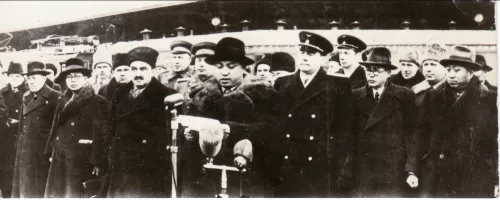
Kim Il Sung during a visit to Moscow, March 1949.
National Archives and Records Administration, Record Group 242, Shipping Advice 2011, Item 6/26. Contributed by Charles Kraus.

Who started the Korean War?
This collection of primary source documents helps to answer this defining question about one of the most significant flashpoints of the twentieth century.
By the end of 1948, the allied occupation of the Korean Peninsula had ended, leaving two rival states—North Korea and South Korea—on a collision course. Tensions intensified as each side vied for supremacy, culminating in Kim Il Sung's pivotal meetings with Stalin in the spring of 1950. Armed with Soviet backing and citing reports of a South Korean military buildup, Kim sought substantial aid from Moscow to prepare for an invasion.
Although North Korea alleged that South Korea initiated the conflict by crossing the 38th Parallel, documents in this collection clearly demonstrate that North Korea made the first move. The collection sheds light on the lead-up to the war, offering records on the failed international diplomacy that led to Korea's division, Kim Il Sung’s extensive consultations with Soviet and Chinese leaders, Communist bloc assessments of South Korea, and the evolution of Kim’s war plans.
American perspectives are also featured, with declassified Central Intelligence Agency reports offering unique insights into the dynamics unfolding in North and South Korea during this critical period. Together, these materials provide a nuanced and comprehensive understanding of the complex factors that ignited the Korean War.
For more coverage of the Korean War on the Digital Archive, see the collections: Korean War, 1950-1953; Korean War Armistice; China and the Korean War; and Korean War Biological Warfare Allegations.
For a collections resource guide see The Korean War: Collections & Resources on DigitalArchive.org.

China's leading historian of the Korean War, Shen Zhihua, explains how Stalin and Mao saw the conflict on the Korean Peninsula and the lasting implications of the war for the Sino-Soviet alliance.
How China did -- and did not -- push Kim Il Sung towards war in the lead up to June 25, 1950.
Kim Il Sung would have never dared to launch the Korean War on June 25 without the approval of Stalin. He also probably wouldn’t have done it without the arms, experts, and rubles that the Soviet Union provided.
Kathryn Weathersby analyzes Soviet documentation on the origins of the Korean War in this CWIHP Working Paper.
A record of a conversation with veteran independence activist Kim Koo provides new details on how leaders in southern Korea saw North Korea in 1948 and their predictions about the likelihood of a war in Korea.
Since the early 1990s, the Cold War International History Project and, later, the North Korea International Documentation Project have published hundreds of documents about the Korean War from Russian, Chinese, and other Eastern Bloc archives.
A bibliography of all Wilson Center publications related to the Korean War – from issues of the Cold War International History Project Bulletin and Working Paper series to blog posts appearing on Sources & Methods and audio and video interviews.